Purchasing an Examination Couch: What You Need to Know
An examination couch is one of the largest pieces of medical furniture in a consulting room, and one of the hardest-working. People sit on it, lie on it, climb onto it, and wipe it down many times a day, and it often stays in place long after most of the equipment around it has been replaced. That makes it a purchase where the wrong choice shows every day, for clinicians and patients alike.
The market also looks more uniform than it is. Two medical examination couches with near-identical photographs can differ in height range, safe working load, mechanism, section layout, upholstery and warranty, and those differences decide how well a couch suits the room, the patients and the work carried out on it.
This guide is written for practice managers, clinic owners and procurement teams buying an examination couch, whether for a single consulting room or a whole new surgery.
In this article, we will cover:
- Working out what the couch needs to do in your setting
- 2 section vs 3 section examination couches
- Fixed, hydraulic and electric height adjustment compared
- Matching the couch to the setting
- The case for electric height-adjustable couches
- How to judge durability, and which brands to compare
- What an examination couch costs
- Accessories and consumables worth budgeting for
- Getting the couch into the room
- Keeping a couch in service
- Where to buy medical examination couches in the UK
- A pre-purchase checklist
Start With The Room And The Work
Many couch-buying problems start before you choose a product because the requirements were never written down. A few questions settle most of it:
- What happens on the couch? Routine examinations and consultations need less positioning flexibility than minor procedures, physiotherapy or gynaecological examinations.
- Who are the patients? Older patients, wheelchair users and patients with reduced mobility all benefit from a low entry height. Larger patients may need a higher safe working load or wider upholstery.
- Who uses it? A couch shared by several clinicians of different heights makes a stronger case for adjustable height than one used by a single practitioner.
- How big is the room? Check the platform length and width against the space, and leave room to work on both sides of the couch and for a wheelchair to approach.
- Where is the power? Electric couches need a nearby socket and a sensible cable route that will not become a trip hazard.
Answering these first turns a long list of medical couches into a short one.
2 Section Or 3 Section Examination Couch?
The section count describes how the platform is divided, and it is the first real design choice.
2 section couches have an adjustable backrest and a single main platform. They cover routine examinations, consultations and general assessments, which is why they are the familiar choice in many GP consulting rooms. The Medi-Plinth 2 Section Examination Couch is a typical example, UK-manufactured and designed for routine examinations, procedures and clinical assessments.
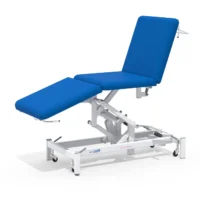
3 section couches divide the platform into back, middle, and leg sections that adjust separately. That gives more positioning flexibility, which suits minor procedures, physiotherapy, assessment and treatment where more precise positioning may be needed. The Medi-Plinth 3 Section Examination Couch is built this way, with a gas spring-assisted back section.
Beyond the standard two, some settings need a specialist design:
- Drop-end couches, such as the Medi-Plinth Drop End 3 Section Couch, can be used as a conventional 3 Section couch or adjusted into a chair.
- Couches with side rails, such as the Doherty Salisbury, are for settings where a patient needs additional support on the platform.
- Low couches, such as the Sunflower Alberti Rest Low Couch, for patient groups that benefit from a lower fixed platform.
If most of your work is routine, a 2 section couch is usually sufficient. If the couch will be used for procedures, therapy, or a varied caseload, the extra flexibility of a 3 section model tends to earn its place.
Fixed, Hydraulic Or Electric: How The Options Compare
Height adjustment is the decision with the biggest effect on daily use, and often on price. Buyers sometimes describe the non-powered options as “manual” couches; in practice, that covers both fixed-height and hydraulic models.
| Feature | Fixed height | Hydraulic | Electric |
| How the height changes | It does not | Foot-operated pump | Motor-driven actuator |
| Power needed | No | No | Yes, mains supply |
| Adjusting mid-examination | Not possible | Possible, but slower | Quick and smooth |
| Relative cost | Usually lowest | Usually lower than electric | Usually highest |
| Worth considering when | Height adjustment is not needed | Adjustment is needed without a power supply | Height changes are frequent, or several people share the room |
Fixed-height couches have no powered or hydraulic lifting mechanism, which makes them the simplest configuration and usually the most economical. Castors, backrests and upholstery still need looking after. The trade-off is that neither patient nor clinician can change the working height, so they suit rooms with a single regular user and a patient group that can climb on comfortably. The Doherty Enfield is a fixed-height example.
Hydraulic couches raise and lower via a foot pump, so they need no power supply. They give most of the flexibility of an adjustable couch, but adjusting height takes more time and effort, which adds up over a busy day.
Electric couches use a motorised actuator to raise and lower the platform. They need a power point, but height changes are quick, and they can be particularly practical where several clinicians share a room or patients need a low entry height.
The price gap between hydraulic and electric is not always large. The Medi-Plinth 3 Section Examination Couch is offered in both versions at similar prices, with a safe working load of 225kg on hydraulic models and 260kg on electric ones, so on that model the choice comes down to how the room is used rather than budget.
Matching The Couch To The Setting
There is no single best examination couch for every clinic, but most settings point clearly towards one type:
- A routine GP consulting room with one regular user: a 2 section couch, where a fixed-height or hydraulic model may be sufficient.
- A busy or shared consulting room: a height-adjustable couch, with electric worth considering where height changes are frequent.
- Physiotherapy, treatment, and minor procedures: a 3 section couch, with a breathing hole and arm extensions if patients lie face down.
- Patients with reduced mobility or wheelchair users: a couch with a low entry height.
- Patients who need extra support on the platform: a side-rail model.
- A smaller room where patients may sit as well as lie: a drop-end couch.
- Larger patients: a higher safe working load, and extra-wide upholstery where available.
The Case For Electric Height-Adjustable Examination Couches
Electric couches can cost more upfront, so it is worth being clear about what the extra costs buy.
- Easier patient access. A couch that lowers to a low entry height is much easier for older patients and those with reduced mobility to get onto. The Medi-Plinth 3 Section adjusts from 46cm to 91cm, and its extra-low entry height supports wheelchair transfers.
- A comfortable working height for each clinician. Height can be set for whoever is using the couch, so a clinician is not working at a height set for someone else – which matters most in rooms shared by several people.
- Adjustment without interruption. You can change the height partway through an examination without stepping away to pump a pedal.
- Reliability of the lifting system. The quality of the actuator matters. The Medi-Plinth range uses Linak actuators for its electric operation.
Electric is not automatically the right answer. For a single-user room with a stable patient group and no convenient socket, a hydraulic or fixed couch may be the more sensible choice.
How To Judge Durability Before You Buy
Rather than relying on a brand name alone, these are the specifications that tell you how well a couch is likely to stand up to daily clinical use:
- Safe working load. Check the stated figure and whether it differs between mechanisms.
- Warranty terms. Frame and moving-part warranties are often different. Medi-Plinth couches carry a 7-year parts and labour warranty on the frame and 3 years on moving parts, covering manufacturing or material defects.
- Upholstery. Look for antimicrobial, fire-retardant medical-grade vinyl. Ask about colour options, extra-wide upholstery, and whether replacement upholstery sections are available if a section is damaged.
- Castors and stability. Retractable castors let you move the couch for cleaning, then lock firmly in place; an adjustable foot helps on uneven floors.
- Manufacture and parts. A UK-manufactured couch with an accessible manufacturer can make replacement parts and repairs more straightforward over its working life.
Which Examination Couch Brands Should You Compare?
Our range brings together three manufacturers, each with a different emphasis:
- Medi-Plinth: UK-manufactured 2 and 3 section couches in hydraulic and electric versions, plus the Ensignia and Drop End models.
- Doherty (Drive DeVilbiss): the fixed-height Enfield, 2 and 3 section plinths, the Winchester, and the Salisbury with side rails.
- Sunflower Medical: the Alberti Rest Low Couch.
Comparing their specifications against the durability points above is a more reliable guide than any ranking.
What Does An Examination Couch Cost?
The price of an examination couch for a GP practice depends almost entirely on the specification chosen. The main drivers are:
- Mechanism. Fixed-height couches usually sit at the lower end, with hydraulic and electric above – though on some models the gap between hydraulic and electric is small.
- Section layout. 3 section couches generally cost more than 2 section models.
- Specialist design. Drop-end couches and couches with side rails typically cost more than standard models.
- Upholstery and options. Extra-wide upholstery, specific colours and accessories all add to the total.
- Delivery and disposal. Removing an old couch is sometimes a separate line item.
Affordable Examination Couches For Small Practices
For a small practice, a fixed-height or hydraulic 2 section couch is usually the most affordable way into purpose-built medical furniture. A lower-cost couch makes good sense where one clinician uses the room, patients can get on comfortably, and the work is mainly routine.
It is still worth checking a cheaper couch against the same points as any other: safe working load, platform dimensions, upholstery quality and warranty. It is also worth thinking a little ahead. A couch that has to be replaced early because a second clinician joins, or because the practice starts seeing more patients with reduced mobility, is not the economical choice it seemed at first.
Accessories And Consumables Worth Budgeting For
Accessories are easy to forget at the point of order and awkward to add later. For the Medi-Plinth 3 Section, for example, the options include:
- A paper roll holder, fitted as standard on this model, and couch rolls to go with it
- A detachable headrest and padded arm table extensions
- A breathing hole, used when patients lie face down
- An electric backrest option
- Extra-wide upholstery
- Transportation castors
- Removal and disposal of your old couch
Specifying these with the couch keeps everything in a single order and quote.
Getting The Couch Into The Room
Delivery is where a well-specified order most often runs into trouble. Examination couches are large and heavy: the Medi-Plinth 3 Section weighs 95kg without accessories, with a platform 186cm long and 63cm wide. Before ordering, it is worth checking:
- The route from the delivery point to the room, including doorway widths, corridor corners, lifts and stairs.
- Where delivery ends. Confirm whether the couch will be delivered to the door or to the room, and whether any setup is needed on arrival.
- Timescales. Confirm delivery timescales when ordering, particularly if you choose a non-standard upholstery colour or additional options.
- The old couch. If you are replacing one, arrange its removal at the same time. Removal and disposal is available as an add-on for Medi-Plinth couches.
Keeping A Couch In Service
A well-chosen couch still needs looking after. Clean upholstery regularly with products compatible with the vinyl; Medi-Plinth’s guidance lists which NHS cleaning solutions and wipes you can use, and which products to avoid because they can harden and crack the surface. Our Medi-Plinth couch cleaning information covers this in detail.
Torn or split upholstery can no longer be cleaned effectively, so repair or replace damaged sections promptly rather than covering them. Inspect electric and hydraulic mechanisms per the manufacturer’s guidance, and our team can advise on support options for your couch once you get in touch.
Where To Buy Medical Examination Couches In The UK
Manufacturers, specialist medical suppliers, and general retailers sell examination couches. For a healthcare setting, a specialist supplier tends to make the process simpler, and it is worth checking that yours can offer:
- A choice across brands, section layouts and mechanisms, rather than a single model
- Formal written quotations for internal approval
- Acceptance of NHS purchase orders, and account terms where eligible
- Clarity on delivery, and whether removal of your old couch can be arranged
- After-sales support if something goes wrong under warranty
A note on VAT: relief applies to certain qualifying purchases made for disabled people, or by eligible charities. It is not a general VAT exemption for GP practices or other healthcare organisations. Our VAT exemption guide sets out who qualifies.
A Pre-Purchase Checklist
Before placing an order, run through the following:
- What the couch will be used for, and by how many clinicians
- 2 section, 3 section or a specialist design
- Fixed, hydraulic or electric height adjustment
- Height range, especially the lowest entry height
- Safe working load for the chosen mechanism
- Platform length and width, and whether extra-wide upholstery is needed
- Upholstery type and colour
- Room size and the location of the nearest power point
- The delivery route, including doors, corridors, lifts and stairs
- Accessories and couch rolls
- Warranty terms
- Removal of any couch being replaced
Examination Couches At HCE
HCE has supplied medical furniture and equipment to GP surgeries, hospitals, clinics and care providers across the UK for over 20 years, and holds BSI ISO 9001:2015 certification. Our examination couches range includes Medi-Plinth 2 and 3 section couches in hydraulic and electric versions, the Medi-Plinth Ensignia and Drop End models, Doherty couches and plinths, and the Sunflower Alberti Rest Low Couch. It sits within our wider hospital furniture range, alongside treatment plinths, stools and screening.
Tell us the rooms, the patients and the procedures, and our team can prepare a quotation covering the couch, mechanism, upholstery and accessories in one place. Request a quotation to get started.
FAQs
How much does an examination couch cost in the UK?
It depends mainly on the mechanism, section layout and any specialist features. Fixed-height couches are usually the most affordable; standard 2 and 3 section height-adjustable couches sit in the middle, and specialist designs such as drop-end and side-rail models sit at the top. Accessories, upholstery options, and removal of an old couch can add to the total, so request a quotation that covers the full specification.
Should I choose a 2 section or 3 section examination couch?
A 2 section couch covers routine examinations and consultations and suits most general consulting rooms. A 3 section couch gives more positioning flexibility, which is useful for minor procedures, physiotherapy and treatment where more precise positioning may be needed. If the room will host a varied caseload, a 3 section model tends to be the more flexible long-term choice.
Is an electric examination couch worth the extra cost?
It depends on how you’ll use the couch. Electric couches make the most sense in busy rooms shared by several clinicians and where patients need a low entry height. On some models, the price difference from a hydraulic version is small, so it is worth comparing both before deciding.
What is the difference between an examination couch and a plinth?
In UK healthcare, the terms are largely interchangeable. “Examination couch” is more common in general practice and hospitals, while “plinth” is more often used in physiotherapy and therapy settings. What matters more is the specification: section layout, height mechanism, safe working load and upholstery.
Can NHS practices order examination couches from HCE?
Yes. HCE supplies examination couches to NHS GP practices, hospital outpatient departments, physiotherapy and MSK services, women’s health clinics and community health centres. NHS purchase orders are accepted, and eligible customers can apply for a 30-day account. Visit our official NHS orders page for more information.