Medical Fridge Buying Guide
Cold storage is one of the few areas of clinical equipment where a small, quiet failure carries an immediate cost. A fridge that drifts outside its intended range overnight can compromise a full tray of vaccines, and that loss of potency cannot be reversed. The consequences land on the practice as wasted stock, cancelled clinics, incident reporting and, in some cases, patients recalled for repeat doses.
That makes choosing cold storage a procurement decision worth taking slowly. There is a considerable difference between a compact benchtop unit for a treatment room and a large glass-door pharmacy refrigerator holding a full seasonal vaccination stock, and the features that matter most vary with the setting.
This guide is written for the people making that decision: practice managers, pharmacy teams, ward managers, laboratory leads and NHS procurement staff.
In this article, we will cover:
- What a medical fridge is, and why a domestic fridge is not a substitute
- Medication fridge, medicine fridge, pharmacy fridge – the terminology explained
- The main types of medical fridges and who uses them
- How to work out the capacity you need
- Features worth comparing before you commit
- Choosing a pharmacy fridge for a GP surgery
- Installation, servicing and whole-life costs
- A practical buying checklist
What Is A Medical Fridge?
A medical fridge is a refrigerator built specifically to store pharmaceuticals, vaccines, blood products, reagents, and biological samples. The defining characteristic is not the cold itself, but its consistency. These units are engineered to maintain a narrow temperature band across the entire internal space and to alert you when they don’t.
Typical features across medical fridges include forced-air circulation to prevent warm and cold pockets, digital temperature displays, minimum and maximum temperature recording, high- and low-temperature alarms, and locking doors on many models.
Current UK guidance on vaccine storage says that they should be stored according to the manufacturer’s summary of product characteristics, which for most refrigerated vaccines specifies +2°C to +8°C. Guidance is periodically updated in the Green Book, so it is worth confirming the current version against your own standard operating procedures before finalising a specification.
Why A Domestic Fridge Is Not An Alternative
This question comes up regularly, usually when a budget is tight or a temporary space needs covering, and the answer in published guidance is consistent: domestic fridges should not be used for vaccine storage.
The reasons are practical rather than bureaucratic. Domestic units cycle their compressors around a target average, which means the actual temperature at any given point inside can sit well above or below the display reading. Cold spots near the evaporator can drop below zero. There is no min/max recording, no alarm if the unit fails overnight, no lock, and no calibration record. A cleaner or a contractor can quietly unplug a domestic fridge without anyone noticing until the following morning.
Medication Fridge, Medicine Fridge Or Pharmacy Fridge?
Buyers use these terms interchangeably, and search results reflect that. In everyday use, they largely describe the same category of equipment, with the label shifting to match the setting:
- Medical fridge is the broad umbrella term, covering everything from ward units to laboratory refrigerators.
- Medication fridge and medicine fridge usually describe a unit holding prescribed medicines, whether in a dispensary, a treatment room or a care home.
- Pharmacy fridge tends to indicate a larger-capacity unit with pharmacy-grade monitoring, typically in a dispensary or a GP surgery running vaccination clinics.
- A vaccine fridge is used where the primary contents are vaccines, though the equipment is often identical to a pharmacy fridge.
The terminology matters less than the specification. When comparing quotes, look past the product name to the temperature range, monitoring features, and door type.
The Main Types Of Medical Fridges
Our medical fridge range is organised by application, which mirrors how most buyers approach the decision.
Pharmacy Fridges
The largest part of our selection covers dispensary and clinic-scale storage from roughly 36 litres up to over 500 litres. Options run from benchtop units such as the Labcold RLDF0224 66-litre solid-door fridge through to the RLDG1819 543-litre glass-door pharmacy and vaccine refrigerator.
Our pharmacy fridge range includes models from Labcold, Lec Medical, Haier Biomedical and Shoreline, with solid-door and glass-door variants and digital-lock versions of many models.
Ward Fridges
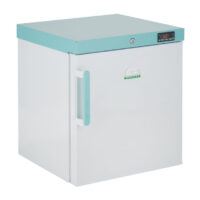
Compact units for medication storage at ward level, where the priority is a small footprint and controlled access rather than volume. Our ward fridges include Lec Medical freestanding and under-counter models, some supplied with locks.
Undercounter, Worktop And Wall-Mounted Fridges
These are ideal where space is the constraint rather than capacity. Undercounter fridges sit beneath a worktop in a dispensary or clinic room, while worktop and wall-mounted models suit consulting rooms where floor space is already committed. Both are worth considering before defaulting to a taller unit that will not fit the room.
Laboratory Fridges And Freezers
Laboratory cold storage covers a broader temperature span than pharmacy storage, and the requirements are different. Our laboratory fridges include spark-free models such as the Labcold RLPR range, intended for environments where flammable materials are stored, alongside laboratory freezers and combined fridge-freezer units for labs needing both in a single footprint.
Blood Bank And Neonatal Fridges
Two specialist categories with distinct monitoring requirements. Blood bank refrigeration supports blood and blood-product storage in transfusion services, and neonatal fridges are designed around breast milk storage in maternity and neonatal settings.
Portable Vaccine Carriers And Thermal Bags
The cold chain rarely stops at the building. Community vaccination clinics, district nursing rounds and outreach services need temperature-controlled transport, which is where portable vaccine carriers such as the Labcold RPDF0012F 12-litre carrier come in.
For shorter journeys, thermal bags with frozen or refrigerated cool blocks offer a straightforward alternative with no mechanical parts to fail. Polar Thermal Products and Labcold are both available at HCE, along with the gel packs and rigid cool blocks the bags depend on.
How To Choose The Right Capacity
Undersizing is the most common regret, and it is not simply about the litre figure on the datasheet.
Published guidance is clear: a fridge should be large enough to allow air to circulate the packages inside. A unit packed to the walls will develop temperature gradients regardless of how good the controller is, so usable capacity is always less than stated capacity.
Some practical points to work through:
- Plan for your peak, not your average. Seasonal influenza and other vaccination campaigns can multiply refrigerated stock for several weeks. A fridge sized for a quiet March will not cope in October.
- Keep vaccines in original packaging. This protects against light and helps with stock rotation, but it consumes noticeably more space than loose vials.
- Account for stock rotation. Space to arrange stock by expiry date reduces waste and reduces the temptation to overfill.
- Check the physical dimensions, not just the volume. Door swing, hinge side, ventilation clearance and access route all matter. For this reason, several Lec Medical models are available with a specified hinge side.
- Consider two smaller units instead of one large one. For larger sites, splitting capacity means a single failure does not put the entire stock at risk.
Features Worth Comparing Before You Buy
Once you’ve settled on the type and capacity, these specification points make the most practical difference day to day.
Glass door or solid door: Glass doors let staff check contents and stock levels without opening the unit, which reduces temperature disturbance during busy clinics. Solid doors give better insulation and no visibility of contents, which some sites prefer for security reasons.
Locking: Guidance indicates vaccine storage should be secure and accessible only to authorised staff, whether through a locking fridge or a locked room. Many of our Labcold models are available in DIGLOCK versions with a digital lock, and some Lec Medical ward units are supplied with locks.
Temperature monitoring and recording: Daily recording of minimum, maximum and current temperatures is standard practice in most settings, with the thermometer reset after each reading. Built-in min/max displays make this straightforward. Some models go further: Labcold units can record temperature data to a microSD card, and Lec Medical’s Pharmacy Plus and Laboratory Plus ranges include Bluetooth monitoring.
Data loggers and alarms: Where a site needs a continuous record independent of manual readings, a separate data logger such as the Lec Medical ATMDL-LCD is worth budgeting for. Our fridge thermometers and monitoring accessories cover both.
Controller type: Touchscreen controllers, including Labcold’s IntelliCold system, tend to be easier for staff to use consistently than dial thermostats, which matters when several people share responsibility for the fridge.
Spark-free construction: Relevant for laboratories storing flammable materials, and not a feature to assume – check that it is specified on the model.
Calibration: Some sites need documented calibration for audit purposes. Labcold calibration certificates can be ordered alongside the unit rather than arranged separately later.
Choosing A Pharmacy Fridge For A GP Surgery
GP surgeries sit in an awkward middle ground. Vaccination volumes can rival a small pharmacy during campaign periods. Still, the available space is usually a treatment room or a corner of a dispensary, not a purpose-built store.
For most surgeries, a pharmacy fridge in the 150 to 340 litre range gives enough headroom for seasonal peaks without dominating the room. The Labcold RLDF0524 150-litre undercounter unit and the RLDF1024 340-litre solid-door refrigerator are both commonly specified at this scale, and the Lec Medical PESR47DC-UK 47-litre unit suits smaller branch sites or a second storage point.
Beyond the fridge itself, a few points are worth settling before installation:
- Who holds responsibility for daily temperature recording, and who covers for them
- Where the unit will be plugged in, and how the socket will be protected against accidental switching off
- Whether the door needs to be lockable, or whether the room itself is secure
- Whether the fridge will be used solely for pharmaceuticals, which published guidance requires
If your surgery is setting up a Labcold unit, our existing article on setting up a Labcold pharmacy fridge walks through the initial configuration.
Installation, Servicing And Whole-Life Costs
The purchase price is rarely the whole figure, and procurement teams comparing quotes on unit cost alone can be caught out later.
Siting and installation: Larger freestanding units need ventilation clearance and a delivery route that accommodates them. Delivery and installation services are available on some ranges, including a premium delivery and collection option for Lec fridges.
Servicing: Following the manufacturer’s servicing recommendations is part of published guidance for vaccine fridges, and it should be clear from the outset who holds that responsibility. Our medical equipment servicing and repairs team supports equipment already in use.
Consumables and accessories: Cool blocks, gel packs, replacement probes, SD cards and calibration certificates all belong in the budget rather than arriving as surprises.
End of life: Refrigeration units fall under WEEE regulations, and collection and disposal services are available for some larger models. Worth factoring in when replacing an existing fridge rather than adding one.
A Practical Buying Checklist
Before raising the order, run through the following:
- Purpose confirmed: vaccines, general medicines, laboratory materials, blood products or transport
- Temperature range matches the SPC requirements of what will be stored
- Capacity allows for peak stock and air circulation, not just current volumes
- Physical dimensions, hinge side and access route checked against the room
- Locking arrangements decided, either at the unit or the room
- Minimum and maximum temperature recording available, with a clear recording routine
- Alarm behaviour understood, including what happens out of hours
- Data logging or calibration documentation specified where audit requirements demand it
- Servicing responsibility agreed
- Disposal of any unit being replaced arranged
Medical Fridges At HCE
HCE has supplied cold storage to GP surgeries, pharmacies, hospital wards, laboratories and community services across the UK for over 20 years, working with Labcold, Lec Medical, Haier Biomedical, Shoreline, Polar Thermal Products and Dometic. We hold BSI ISO 9001:2015 certification, and our team can help match a specification to the room and the workload rather than simply quoting on litres.
Whether you are fitting out a new dispensary, replacing a unit that has started drifting, or costing a wider cold-chain refresh across a trust or a community service, we can confirm specifications, current availability and pricing. Request a quotation with the details of your setting, and we will come back with suitable options.
FAQs
What is the difference between a medical fridge and a domestic fridge?
A medical fridge is designed to maintain a narrow, consistent temperature throughout the entire internal space, and to record and alarm if it does not. Domestic fridges cycle around a target average, produce cold and warm spots, and offer no min/max recording, alarms or locking. Published UK guidance indicates domestic fridges should not be used for vaccine storage.
What temperature should a medical fridge be set to?
Storage requirements come from the manufacturer’s summary of product characteristics for the specific product being stored. For most refrigerated vaccines, this is +2°C to +8°C. Your own standard operating procedures and the current version of Green Book Chapter 3 should be the reference point rather than a general figure.
Do I need a lockable medical fridge?
Guidance indicates that vaccine storage should be secure and restricted to authorised staff, which can be achieved either through a locking fridge or by siting it in a locked room. Many models are available with mechanical or digital locks, so decide which approach applies to your site before ordering.
How often should a medical fridge be serviced or calibrated?
Follow the manufacturer’s servicing recommendations for the specific model, and assign responsibility for arranging it rather than assuming it. Where documented calibration is needed for audit purposes, calibration certificates can be ordered alongside the unit.
Can NHS GP surgeries and pharmacies order medical fridges from HCE?
Yes. NHS GP surgeries, hospital pharmacies, ward teams, pathology laboratories, blood banks and community vaccination services all order cold storage from us. We accept NHS purchase orders, and eligible customers can apply for a 30-day account. Visit our official NHS orders page for more information.